
Fields in Clarke County Property Tax Records
Clarke County assessment and collection records track related but distinct numbers. The appraised value is a valuation judgment about what the property is worth. The assessed value applies Alabama's classification ratio to that figure. Exemptions and district millage then shape what the tax bill actually says. Read each number with its record year attached.
| Field | What It Shows | Where |
|---|---|---|
| Appraised value | Estimated full value for the stated year | Revenue parcel card |
| Assessed value | Appraisal multiplied by the state class ratio | Assessment record |
| Land / improvements | Components supporting total appraisal | GIS card |
| Exemptions | Approved relief affecting taxable assessment | Revenue Commissioner |
| Bill / payment history | Annual amount and status | AssuranceWeb |
A sale amount sits inside a dated conveyance, so it may not match the appraisal at all. Assessed value is not a second guess at market price. It is the statutory base that millage applies to.
Search AssuranceWeb With Clarke Parcel Keys
The Clarke County AssuranceWeb search accepts owner name, PIN, parcel, account, subdivision, or address. Begin broad enough to absorb spelling and abbreviation differences. Then narrow the results down to a single parcel identity. Its official introduction says payment and appraisal history reaches back more than ten years. It names no exact first year, though.
| Search key | Useful when |
|---|---|
| Owner | The assessment name is known |
| PIN / parcel | A tax-map identifier is available |
| Account | Returning to a revenue account |
| Subdivision | Grouping a named development |
| Address | Starting from the physical location |
The official property search displayed here is the natural starting surface for Clarke County property tax records.
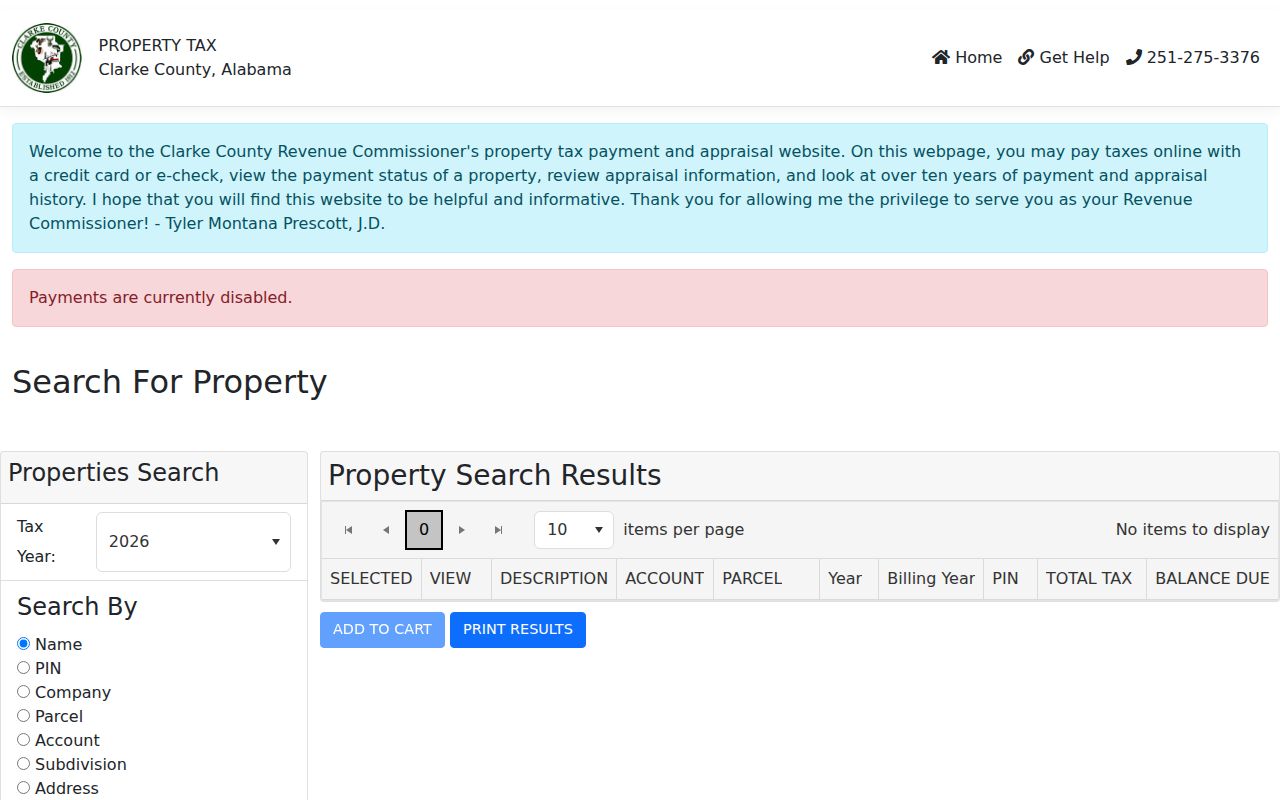
Capture the selected parcel number, tax year, values, exemptions, and status before comparing records.
Retrieve a Clarke County Tax Bill
Assessment and collection both sit with the Revenue Commissioner. Rely on parcel identity rather than an owner name alone, and open each tax year separately when pulling a Clarke County tax bill.
- Search AssuranceWeb by address, PIN, parcel, or account.
- Confirm the physical description and tax year.
- Read appraisal, assessed value, exemption, bill, and payment status.
- Compare prior years without mixing revaluation periods.
- Ask Revenue about unclear delinquency or lien-sale status.
- Assessed value
- Appraised value after the property-class ratio.
- Millage
- Tax applied per thousand dollars of assessed value.
- Homestead exemption
- Approved relief for a qualifying owner-occupied primary residence.
- Tax lien
- A statutory claim arising from unpaid tax, not ownership acquired by payment.
Current county guidance sets October 1 as the due date, with delinquency after December 31; manufactured-home taxes turn delinquent after November 30. Payment works online, in person, or by mail. Follow the current mailing instructions, and include a self-addressed stamped envelope when you request a receipt.
Apply Alabama Class Ratios to Clarke Values
The Alabama Department of Revenue assessment guide sets out the core formula. Appraised fair-market value times classification ratio equals assessed value. Class I utilities carry 30 percent. Class II property not otherwise classified carries 20 percent. Qualifying Class III property covers agricultural and forest land, owner-occupied single-family homes, owner-occupied manufactured-home land, and historic property. It carries 10 percent. Class IV vehicles carry 15 percent. Current-use valuation can pull qualifying Class III land away from ordinary market valuation. A full tax estimate therefore requires the correct class, district millage, exemptions, and year. It needs more than an appraised value copied off a card. Note: Keep portal labels such as appraised, assessed, taxable assessed, and sale distinct rather than treating them as synonyms.
Clarke Homestead Relief Runs H-1 Through H-4
The ALDOR homestead guide describes the H-1 through H-4 categories. Eligibility hinges on owning and occupying a single-family primary residence. That occupancy must exist on the first day of the tax year. Age, disability, and income conditions separate the categories. Applications go through the Clarke County Revenue Commissioner. Never infer qualification from an age or owner name shown online. H-1 generally supplies the regular state and county assessed-value exemptions. H-2, H-3, and H-4 deliver different relief under their own age, disability, or income rules. Check the current checklist and supporting documents with the county before leaning on a prior-year exemption. Alabama defines the homestead as the qualifying dwelling and land. It can reach up to 160 acres. Still, the exemption depends on the statutory category and current evidence. H-2 and H-4 do not deliver identical county relief. H-3 applies its own income or permanent-and-total-disability conditions. An exemption displayed for one year proves nothing about another year. Ownership, occupancy, or status changes can undo it. Record the application year, the exemption code, and whatever documentation the Revenue Commissioner requires. After a recent home purchase, complete the deed-recording and assessment steps instead of assuming the seller's exemption transfers. The assessor record, the tax notice, and the recorded deed should all agree on the parcel. The displayed owner or exemption may lag behind in the meantime.
Alabama's Cap Is Not Market Value
Act 2024-344 guidance caps certain annual increases in taxable assessed value at seven percent. It applies to Class II and Class III real property. The cap is tied to the applicable base and collection years. Exceptions cover some ownership changes, class changes, never-assessed property, and new improvements.
The cap does not freeze market value, sale price, or the bill itself. A district-rate change can move the result. So can an exemption change, an improvement, or a statutory exception. Compare the underlying card and year before concluding the cap was misapplied.
Tax Payment Does Not Convey Land
The Revenue page links tax-lien material, and county legal notices document earlier lien-sale decisions. No current-year result list appears among the county's published materials, so ask the office for the present notice, the sale method, redemption status, and the parcel-specific record rather than applying an older notice to a current property. ALDOR's delinquent-property guidance warns plainly that paying another parcel's delinquent taxes does not make the payer its owner. A tax lien, an auction interest, a redemption, and an eventual conveyance are distinct stages.
Tax payment is not a deed. Verify the tax instrument, redemption record, and any recorded conveyance before drawing an ownership conclusion.
Clarke Tax Bills May Lag Ownership
Alabama's purchase-property guidance flags a common timing trap. A tax bill can still name the prior owner. That can happen after a sale closes during the year. The fix starts with the buyer. Record the deed and assess the property in Clarke County promptly. The county publishes no numeric refresh-lag promise. So treat three displays as separate things: the dated parcel card, the bill recipient, and the most recent Probate conveyance. Disagreement among those names does not mean the sale failed. It usually means the records simply have not caught up with each other yet.
Work the mismatch in order. First confirm the parcel and tax year match. Then read the deed reference on the current card and pull that instrument from Probate. After that, contact Revenue. Provide the deed date, book and page, parcel number, and tax year. An outdated bill name never erases a recorded conveyance. A newer assessment name, standing alone, proves nothing about a clean title chain either.
The Revenue Commissioner must maintain ownership maps from recent recorded conveyances. But "current" describes that duty rather than same-day sync. Be careful with mailing addresses. They may only show where the office sends correspondence. That can sit far from the physical parcel. Read them as clues, not conclusions.
Compare Clarke Land and Improvement Components
Clarke County GIS cards split valuation into labeled fields. These include land, building, improvements, total market or appraised value, and assessed value. Those components matter. Acreage alone cannot predict a bill. A vacant or timber parcel can post substantial land value with zero building value. A developed commercial parcel parks most of the appraisal in structures and improvements. Same county, opposite profiles.
The Walgreens Subdivision sample makes the math visible. It separates $236,300 in land, $1,066,200 in building value, and $1,302,500 in appraised value. Treat those as sample portal values tied to one card and one appraisal context. Never treat them as countywide benchmarks. A rural sample showing 20 acres with no improvements illustrates the flip side. Compare like tax years, classes, districts, acreage, and improvements before drawing any conclusion.
Questioning a characteristic takes a different path than questioning the appraisal. Open the building or improvement tab. Note year built, class, base or heated area, and the improvement entries. A factual error in the property description is one thing. Disagreement over appraisal judgment is another. Name which one you are contesting. Save screenshots and documents before starting an appeal.
Note: Sample values explain field relationships; they are not comparable-sale opinions or estimates for another Clarke County parcel.
Appeal a Clarke County Assessment on Time
The Revenue Commissioner page links a 2026 value-appeal form. ALDOR says a preliminary valuation appeal must be written to the County Board of Equalization within 30 calendar days after the written valuation notice. A final assessment appeal generally proceeds within 60 days after mailing or service to the Alabama Tax Tribunal or circuit court, subject to the applicable payment or bond rules.
Save the notice, envelope, parcel card, tax year, photographs, deed, survey, and comparable evidence that directly addresses the contested characteristic or value. Begin with the county appraisal route at P.O. Box 9, Grove Hill, or telephone 251-275-3376; confirm where and how the current form must be filed.
Appeal window. The preliminary route is 30 calendar days from written notice; final-assessment review generally has a 60-day window. Confirm the controlling notice and filing rules.