
Compare Clarke County Values
A Clarke County property value comes in more than one flavor. The assessor starts with an appraised, or market, value. Applying the state class ratio produces an assessed value. That assessed value may split into land and improvement parts. A deed or sale record can add a historical consideration amount. Each figure answers a different question and may carry a different date.
| Value type | Meaning | Official source |
|---|---|---|
| Appraised or market | County estimate of fair and reasonable market value | Revenue assessment and GIS card |
| Assessed | Appraised value multiplied by the property class ratio | Revenue assessment record |
| Recorded sale | Consideration or price tied to a past transfer | Deed, RT-1, or GIS sale fields |
| Land and improvements | Components that help explain the total | GIS Land, Bldg, and Imp views |
Alabama sets the class ratios. Class II property is published at 20 percent, while qualifying Class III property, including specified owner-occupied homes and agricultural or forest land, sits at 10 percent. Utilities fall under Class I at 30 percent. Check classification and current-use treatment before comparing assessed values.
Clarke's Commercial Value Split
The Walgreens Subdivision sample shows why one total can hide useful detail. Its current card lists $236,300 for land and $1,066,200 for the building. The total comes to $1,302,500 in appraised value. Pavement, curbing, lighting, and a fence appear as improvements. These are observed assessment fields for one parcel, not a countywide price model. The official commercial parcel card places each value component in its record context.
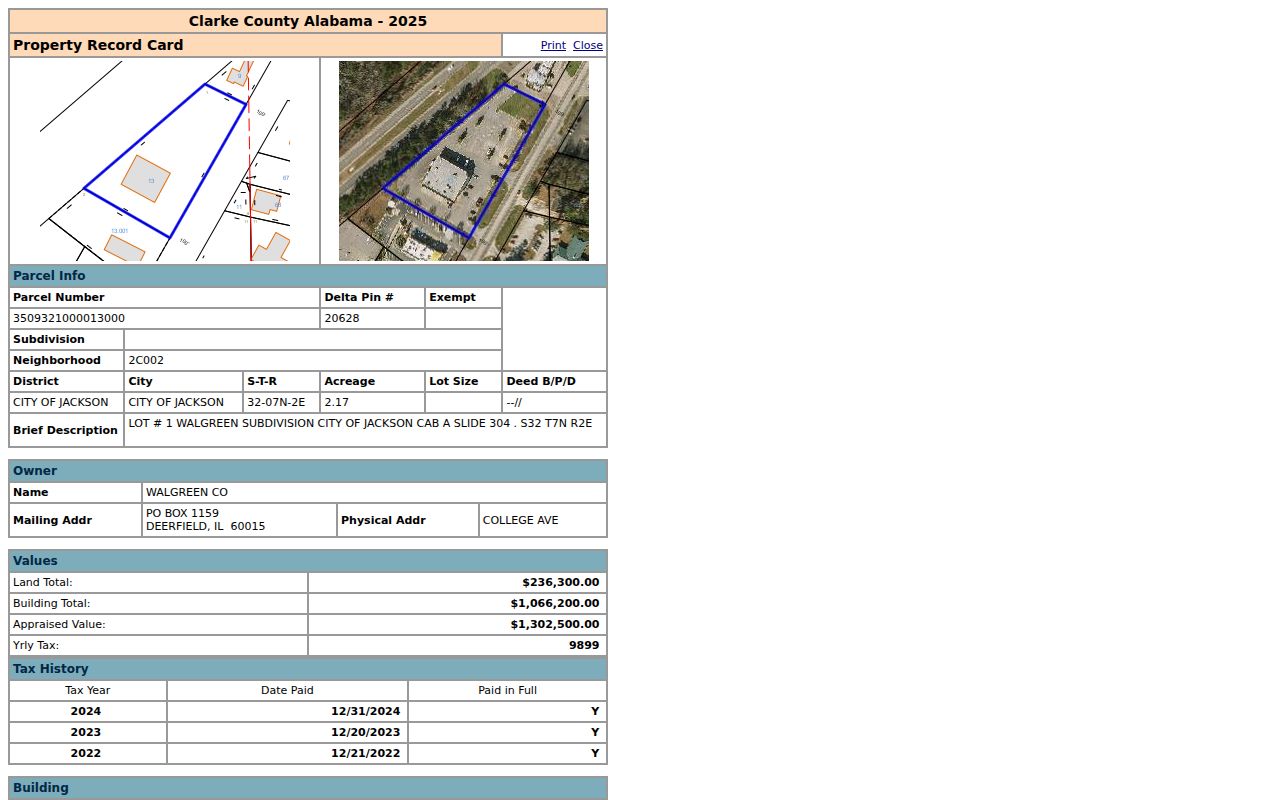
The parcel card also ties the parcel to Lot 1, CAB A slide 304, a building year, and acreage. Those facts help explain the assessment. They do not turn the displayed amount into a private appraisal.
Check a Clarke County Value
Start with one parcel and one record year. That keeps the comparison clean. The AssuranceWeb property search lets you reach a card by address, owner, PIN, parcel, account, company, or subdivision, and once it opens you should copy each field exactly as the Clarke County portal labels it.
- Search the physical address, then confirm the PIN and parcel key before reading a value.
- Record the appraisal or revaluation year, land, improvement, market or appraised, and assessed fields shown.
- Check the Sale Information view for grantor, grantee, price source, date, and deed book/page.
- Compare another parcel only after matching class, year, acreage, improvements, district, and exemption context.
- Assessed value
- The appraised value after the state classification ratio is applied.
- Appraised value
- The county's estimate of fair and reasonable market value.
- Assessment ratio
- The class percentage used to convert appraised value to assessed value.
- Consideration
- The amount stated for a recorded transfer, which can require context.
Calculate Clarke Assessed Value
The Alabama Department of Revenue supplies the core formula. Assessed value equals appraised fair and reasonable market value multiplied by the classification ratio. Picture a $100,000 property. A 20 percent Class II ratio produces $20,000. A 10 percent Class III ratio produces $10,000. That example is pure arithmetic, not a Clarke parcel valuation. Current-use treatment can value qualifying agricultural or forest property differently from ordinary market value. Homestead treatment hinges on ownership, occupancy, and the first day of the tax year. Age, parcel appearance, and mailing address reveal nothing about class or exemption. Never infer one from them. Note: The assessment ratio explains assessed value. District millage and exemptions are separate parts of the tax-bill calculation.
Read Clarke Improvement Values
A zero building value is often correct. Vacant and unimproved land in Clarke County legitimately shows none. The Jackson sample for White Smith Land Company spans 123 acres. It lists $185,200 in land and appraised value, with no building value at all. Contrast that with the Walgreens parcel. It carries a large building component plus listed site improvements. Check the Bldg and Imp views before assuming the county missed a structure. The building search shows year built, class, base and heated area, and improvement-value ranges. A blank field, a zero, and an omitted record are three different things. When the site and card conflict, ask Revenue which record year applies.
Compare Clarke Sale Records
A recorded sale price is historical. It documents what happened, not what a Clarke County parcel is worth today. The GIS Sale Information Search filters by grantor, grantee, price and date ranges, price source, deed book and page, appraisal year, parcel, use code, subdivision, neighborhood, district, and more. A zero-dollar or nominal transfer often signals an estate, a correction, a family transfer, or a structure that only the deed itself will explain.
Read the RT-1 value or consideration alongside the instrument date and terms. Never relabel a GIS TMkt field or a recorded price as today's market price. For a strong comparison, gather several arms-length sales with similar location, use, improvements, and dates. When you need a present opinion of value, seek qualified appraisal work.
Understand Alabama's Value Cap
Act 2024-344 limits increases in taxable assessed value to 7 percent a year. It covers qualifying Class II and III property in the years the law specifies. Several situations fall outside the cap. An ownership change can reset it. So can a class change, a new improvement, or property that was never on the tax roll before. The cap also leaves market value alone. A sale price, an appraisal, an assessed value, and a taxable assessed value are still four different numbers. The cap does not blur them together.
Clarke's Revenue page links a 2026 value-appeals form. The revaluation GIS carries a March 9, 2026 build label. That build date shows the portal is current. But it does not mean every parcel was valued that same day. For bill details, exemption rules, deadlines, or an appeal, use the Clarke County property tax records resource.
Compare Clarke Parcels Carefully
Two Clarke County parcels sit side by side. They can carry very different values. The reasons make sense once you look closer. Acreage matters. So do property class, current use, exemptions, and the tax district. Building age, building area, site work, and the appraisal year each push a number up or down. The GIS neighborhood label helps you group similar parcels for a search. It cannot prove the two lots are true market peers or even part of the same subdivision.
Keep every source field and date intact. The rural sample shows land and TMkt fields of $25,300 with no improvement value. The commercial card splits a seven-figure appraised total between land and building. Those two records answer different assessment questions. Averaging them without a defensible valuation method would distort both.
The GIS Sale Information search offers a stronger dated comparison. It returns grantor, grantee, sale price, sale date, deed book and page, deed date, use code, appraisal year, and parcel filters. Tie any returned amount to its instrument before calling it consideration. Probate's RT-1 rule records the actual purchase price or actual value for covered conveyances. That documentary figure is still not a fresh appraisal. Before comparing sales, confirm the parcels match on use, tax year, acreage, and improvement mix. Save the search date with every comparison you keep.
Clarke County Value Limits
A Clarke County assessed value exists to serve the property-tax system. It does not guarantee a sale price. It will not settle a purchase negotiation. It will not prove insurance replacement cost. Nor will it substitute for a parcel-specific private appraisal. GIS itself disclaims accuracy, timeliness, and completeness. Treat the display as a dated official assessment field, nothing more.
Some issues sit beyond any tax card. A legal boundary or a title defect can move value in ways the card cannot resolve. A physical condition can too. Read the deed and plat, and order a survey when needed. Rely on a licensed appraiser for a current market opinion. Keep the source year beside every number.
Value is not price. A Clarke County assessed value supports taxation. It is not a promise of what the property will sell for and is not an appraisal.